Draft: every number and quote on this page is invented placeholder content, not yet reviewed or approved by the organisation named.

Case study

Eleven centres, one record per child

Attendance in one system, funding returns in a spreadsheet, staff records in a shared drive and incidents on paper. Census week took three people a fortnight. It now takes one afternoon.

11
centres
1,340
children
4 → 1
systems
Type
Kindergarten association
Region
Hamilton and the Waikato
Centres
11
Children
1,340 enrolled
Staff
186, including relievers
With Oversite
Since early 2025

Four systems that never met

None of it was anyone's fault. It had grown one centre at a time over eleven years, and every part worked on its own. What did not work was any question that crossed two of them.

Attendance

A tablet at each centre, exported monthly

Funding returns

Rebuilt by hand in a spreadsheet

Staff records

Folders on a shared drive

Incidents

Paper, filed at the centre

One record per child

Attendance, funding, billing, health and the family's own view of it all, read from the same enrolment. A question that used to cross two systems now crosses two tabs.

  • Enrolments
  • Attendance
  • Funding & RS7
  • Billing
  • Staff records
  • Rosters
  • Health & safety
  • Governance
  • Reports
  • Guardian portal

Where the time went

Not the daily work. Teachers signed children in, managers approved leave, invoices went out. The cost sat in every question that needed two systems at once, and those were the questions that mattered most.

Which certificates lapse before the end of term. Whether a centre held ratio on a specific Tuesday in March. How much a family owed once a credit note from two months ago was taken into account. Each of those took half a day and produced a number nobody entirely trusted.

I used to keep my own spreadsheet of when everyone's certificates ran out, because I did not trust the one on the drive to be current.
Placeholder Name · Centre Manager

How the move ran

Nine months, two centres at a time. The order was chosen deliberately, and the part that took longest was not the software.

  1. 1

    Months 1–2

    Two centres, the tidiest data first

    Enrolments, children and guardians imported. Historical attendance was deliberately left behind, because a clean line was judged worth more than a complete history, and the old system stayed read-only for two years.

  2. 2

    Month 3

    One vocabulary for eleven centres

    The longest part of the whole move, and none of it technical. Eleven centres had each named rooms, session types and absence reasons differently. Agreeing one set took six weeks.

  3. 3

    Months 4–7

    The remaining nine, two at a time

    A fortnight of overlap per pair, with both systems live. No centre ran on two systems for longer than that, which is what stopped the move becoming permanent.

  4. 4

    Month 8

    Funding returns moved across

    The first RS7 built from recorded attendance rather than from an export. Checked against the spreadsheet for two returns, then the spreadsheet was retired.

  5. 5

    Month 9

    Staff records and safety checks

    Left until last on purpose. Certificates and police vets were the messiest data and the least urgent to move, so they went once everything else was steady.

Census week, in an afternoon

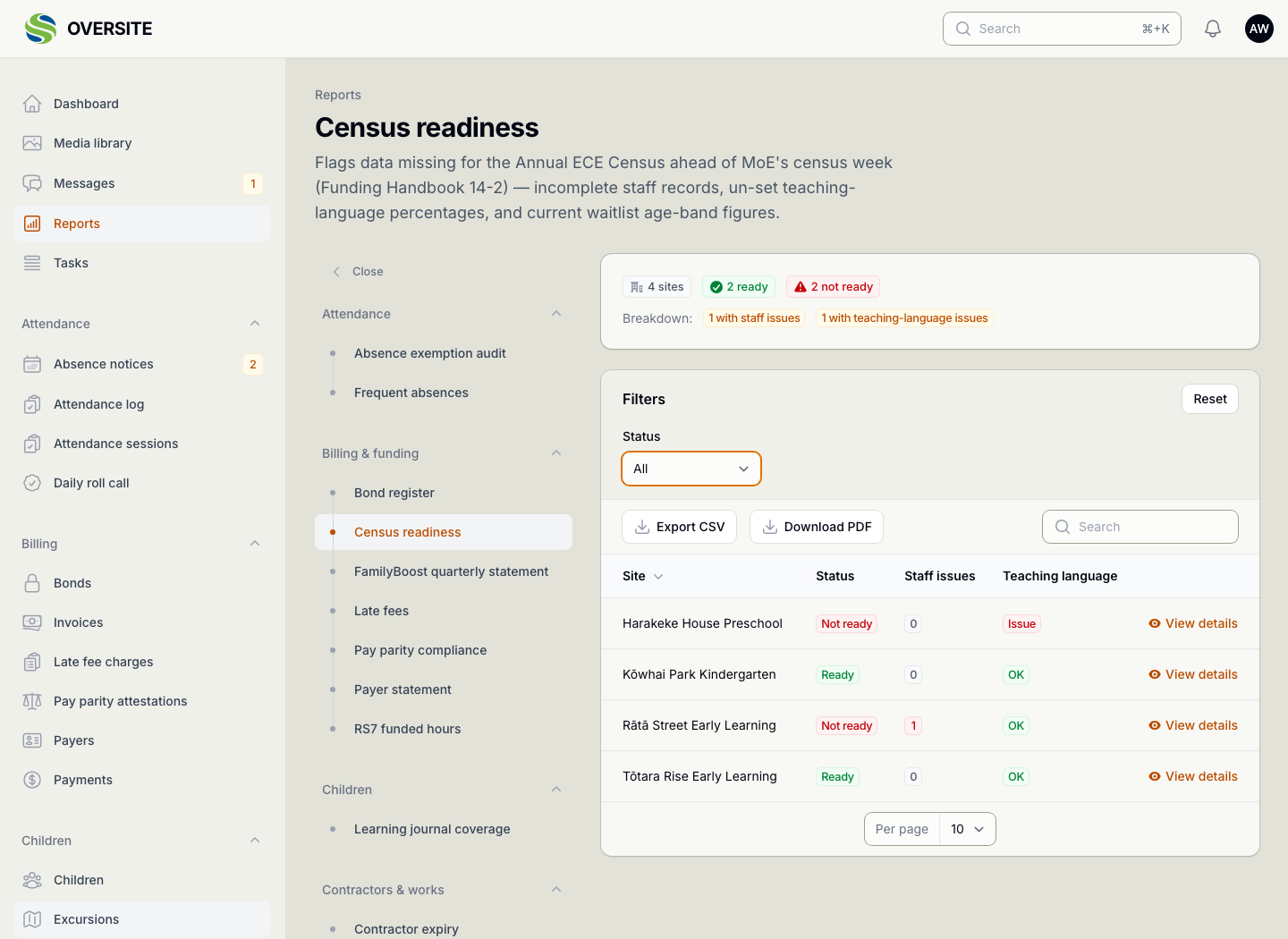
The fortnight was never the counting. It was assembling the thing to count from four exports and reconciling them against each other.

Reading the same records the rest of the year runs on removes that step entirely, which is why the saving is measured in weeks rather than percentages.

  • Built from records that already exist
  • Gaps listed before the return is filed
  • Reproducible as at any date
  • Same figures the funding return reads
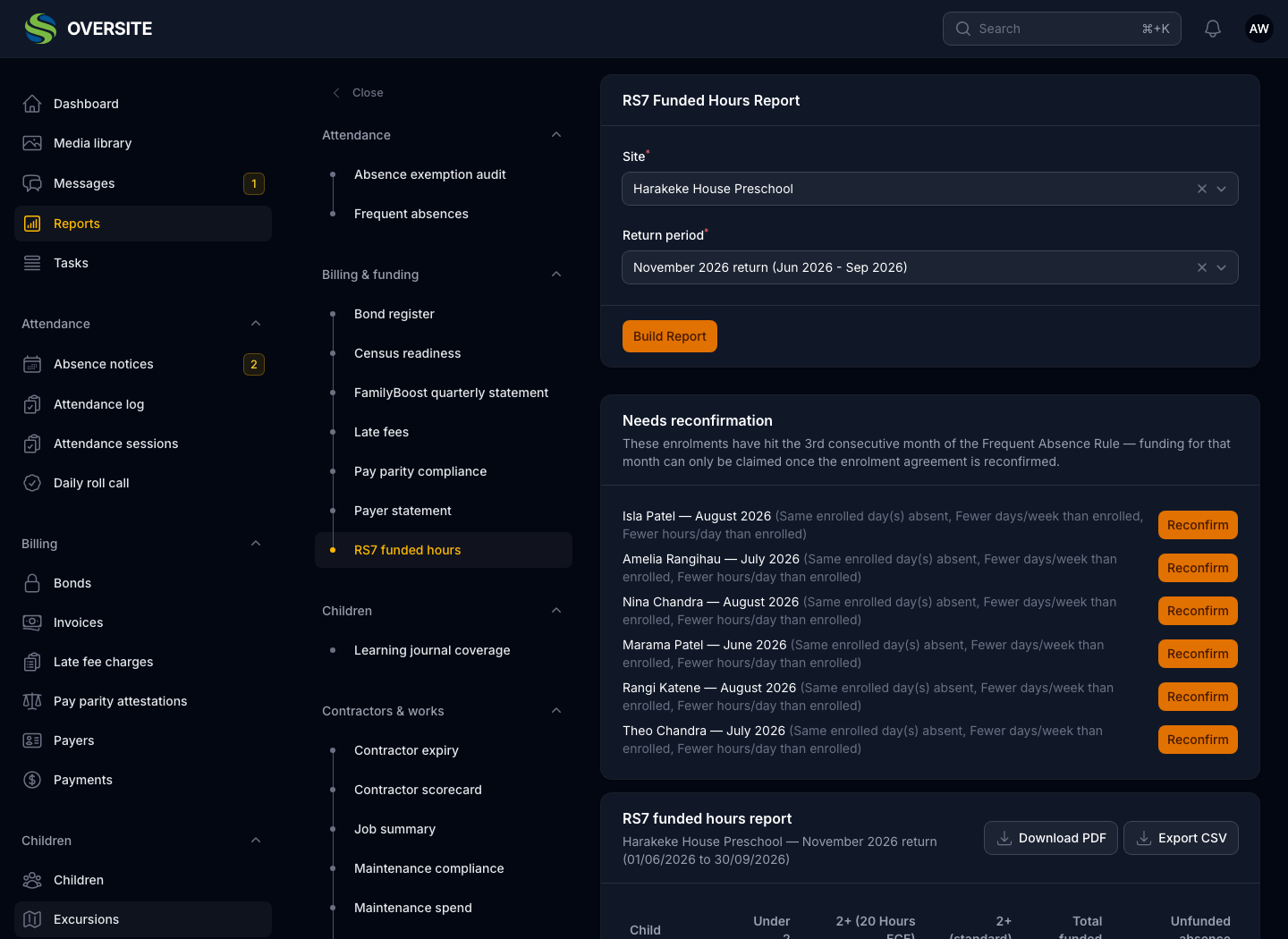
The census readiness report listing what is still missing before the return can be filed. The RS7 funded hours report in dark mode, built from recorded attendance.

What changed, measured

The association's own figures, comparing the twelve months before the move with the twelve months after.

Census preparation

Three people, two weeks

One person, one afternoon

Monthly funding return

Rebuilt by hand from exports

Read from recorded attendance

Certificate expiry

Noticed on the day

Flagged six weeks out

Family account queries

Half a day to answer

On screen, netted per payer

Ratio evidence

Reconstructed from timesheets

A report, as at any date

Systems paid for

Four

One

We did not buy this to save money. We bought it so that when the Ministry asks a question, the answer takes ten minutes and I believe it.
Placeholder Name · General Manager, Waikato Kindergarten Association

See it against your own setup

Tell us how many centres you run and what you're using now. You'll hear back within one working day.

Book a demo